
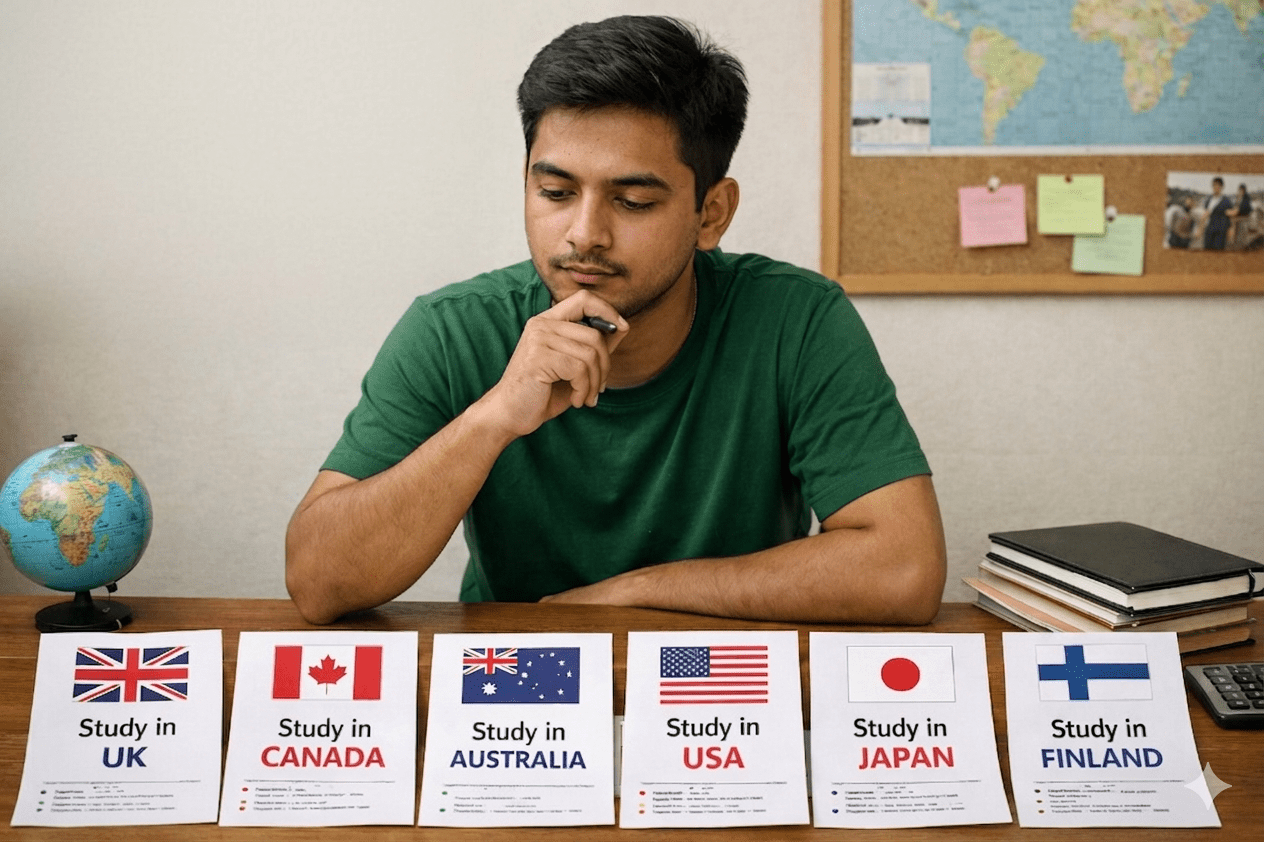
As a counsellor working with Bangladeshi students every day, I hear one question more than almost any other: “Which country is best for higher studies?” It is a natural question, but it is not really the right first question.
The better question is this: “Which country is best for me?” That one change in thinking can save a student from making one of the biggest mistakes in the entire study abroad journey, choosing a country because it sounds popular, while ignoring whether it actually fits the student’s profile, budget, goals, family comfort, and long-term plan.
There is no single best country for every Bangladeshi student. The UK, Canada, Australia, the USA, Japan, and Finland all offer strong opportunities, but they do not offer the same kind of journey. The application process, document culture, financial expectations, student lifestyle, language environment, and post-study direction can feel very different from one destination to another.
This guide is written to help Bangladeshi students compare these six countries in a simple and realistic way before they start applying.
- Start with yourself before you start with the map
Before you compare countries, compare yourself honestly. What subject do you want to study? How strong are your grades? How comfortable are you in English? Is your family looking for a lower-cost option, a highly ranked option, a safer and calmer student life, or a long-term settlement-oriented plan? Do you want a fast and focused degree, or a broader campus experience? Your answer to those questions should shape your shortlist much more than social media trends or advice from random friends.
Students often waste months comparing countries when they have not even defined their own priorities. If your budget is tight, that matters. If your parents want a country with a smaller cultural shock, that matters. If you are aiming for research, employability, or a very specific industry, that matters too.
- What Bangladeshi students should compare before choosing a country
I usually advise students to compare six practical things: academic fit, total cost, document difficulty, visa clarity, lifestyle fit, and future direction. Academic fit means whether the country offers the kind of programs and learning environment you actually want. Total cost means not only tuition, but living costs, insurance, deposits, and emergency funds. Document difficulty means how demanding the application and visa process will be from your side. Lifestyle fit means weather, food, transport, community, language, and daily comfort. Future direction means what kind of options may open up after graduation and whether that matches your own plan.
Once you use those six filters, country comparison becomes clearer and far less emotional.
- The UK: strong for students who want a clear and focused route
The UK is often a very suitable option for Bangladeshi students who want a familiar English-speaking study environment and a relatively structured process. Officially, the student route centres on an approved course, a sponsoring institution, proof of funds, English-language evidence, and additional items such as a tuberculosis test or ATAS certificate when applicable. That means the UK is usually a strong fit for students who like clarity and can prepare documents carefully from the beginning.
From a student perspective, the UK often appeals to those who want an academically focused path without too much confusion around the initial route. It can work especially well for students who are confident in English, want a well-recognised degree, and prefer a destination where the application story is easier for families to understand. But students still need to plan finances properly and avoid assuming that a UK offer letter alone means they are ready for the visa stage.
- Canada: attractive for students who want a broad long-term plan but must stay updated
Canada remains very attractive for Bangladeshi students because many families see it as a country with a strong student ecosystem and long-term appeal. However, Canada is also a country where students must pay close attention to current policy updates. Officially, study permit applicants need a letter of acceptance from a designated learning institution, and many applicants also need a provincial or territorial attestation letter, along with proof of financial support and other required documents.
What this means in simple terms is that Canada can still be an excellent choice, but it rewards students who are organised and realistic. It is a good fit for students who want a North American study experience and are willing to follow changing requirements carefully. If a student is careless with document preparation, financial planning, or school selection, Canada can become stressful very quickly.
- Australia: a good fit for students who value structure, quality, and strong preparation
Australia is another strong English-speaking destination, and it suits students who are ready for a well-documented application process. The official student visa route is the Subclass 500 visa. Students are expected to show genuine student intent, required academic and English evidence, financial capacity, and appropriate health insurance such as Overseas Student Health Cover. In practice, Australia tends to reward applicants who prepare clean documentation and answer the “why this course, why this country, why now” question properly.
For Bangladeshi students, Australia can be a very good choice if they want a respected study destination with a clear system and a high standard of student support. But it is not ideal for casual applicants who want to rush. Australia is better for students who are serious, organised, and able to present a credible study plan from the start.
- The USA: excellent for ambitious students who want breadth, competition, and confidence
The USA is different from the others because many students are not just choosing a country; they are choosing an ecosystem of institutions, majors, campuses, and opportunities. Officially, students first need admission from a SEVP-certified school, then a Form I-20, SEVIS fee payment, and a visa application and interview. That structure means the USA often demands not only documents but also personal confidence and clarity of purpose.
I usually tell Bangladeshi students that the USA is a very strong option for those who are ambitious, flexible, and ready to build a profile, not just submit paperwork. It can suit students who care deeply about subject choice, scholarship competition, research, or campus variety. But the American route often requires a student to explain their goals clearly and carry themselves well, especially during the visa stage. It is a country for students who are ready to think independently.
- Japan: ideal for students who want something different and are open to adaptation
Japan is a very important option that many Bangladeshi students still overlook. Officially, the student visa process typically involves a passport, visa application form, photograph, and a Certificate of Eligibility. Students in Japan can also seek separate permission for part-time work during their studies. This means Japan has a clear formal structure, but success there depends heavily on a student’s readiness to adapt to a different culture and, in many cases, a different language environment.
Japan can be a strong fit for students who are interested in technology, innovation, disciplined academic culture, or a more distinct international experience. It may suit students who are patient, respectful of systems, and willing to prepare for life beyond the classroom. Even where English-medium study options exist, students should think honestly about whether they are ready for the social and cultural adjustment that Japan may require.
- Finland: a smart option for students who want quality, calm, and a modern learning environment
Finland has become increasingly interesting for Bangladeshi students who want a high-quality education system in a smaller, calmer, and highly organised environment. Officially, studies longer than 90 days require a residence permit for studies. Students need admission, proof of funds, insurance, and identity verification, and Finland’s immigration guidance makes these expectations very explicit. For many students, that clarity is actually a strength.
From a student perspective, Finland can be an excellent match for those who value safety, innovation, academic seriousness, and a quieter student life. It may particularly suit students who do not want the noise and pressure of more crowded study destinations. But students should also understand that Finland is a country where self-management matters. If you choose Finland, choose it because the style of life and learning suits you, not only because the destination sounds trendy.
- So which country is right for which kind of student?
If you want a straightforward English-speaking route with a very familiar study-abroad narrative, the UK may feel more comfortable. If you want Canada, choose it with your eyes open and your documents strong, because policy awareness matters there more than ever. If you want Australia, be ready to prove that your study plan is genuine and well prepared. If you want the USA, build not only your file but also your voice and confidence. If you want Japan, prepare for adaptation and do not underestimate culture and language. If you want Finland, be honest about whether you want a quieter but highly disciplined study life.
The right choice is the one that matches your academic direction, financial reality, personal comfort, and long-term plan at the same time.
- My final advice to Bangladeshi students
Do not choose a country because somebody else got a visa there. Do not choose a country because one friend said part-time jobs are easy. Do not choose a country only because a consultant pushed it. And do not choose a country before understanding the application and visa logic behind it.
A strong country choice feels balanced. It makes sense on paper, it makes sense to your family, and it makes sense to your future self. That is the kind of decision students should aim for.
In my experience, students succeed when they stop asking, “Which country is best?” and start asking, “Which country fits my profile, budget, and future properly?” That is where smart decision-making begins.